
(Leggi questo post in Italiano)
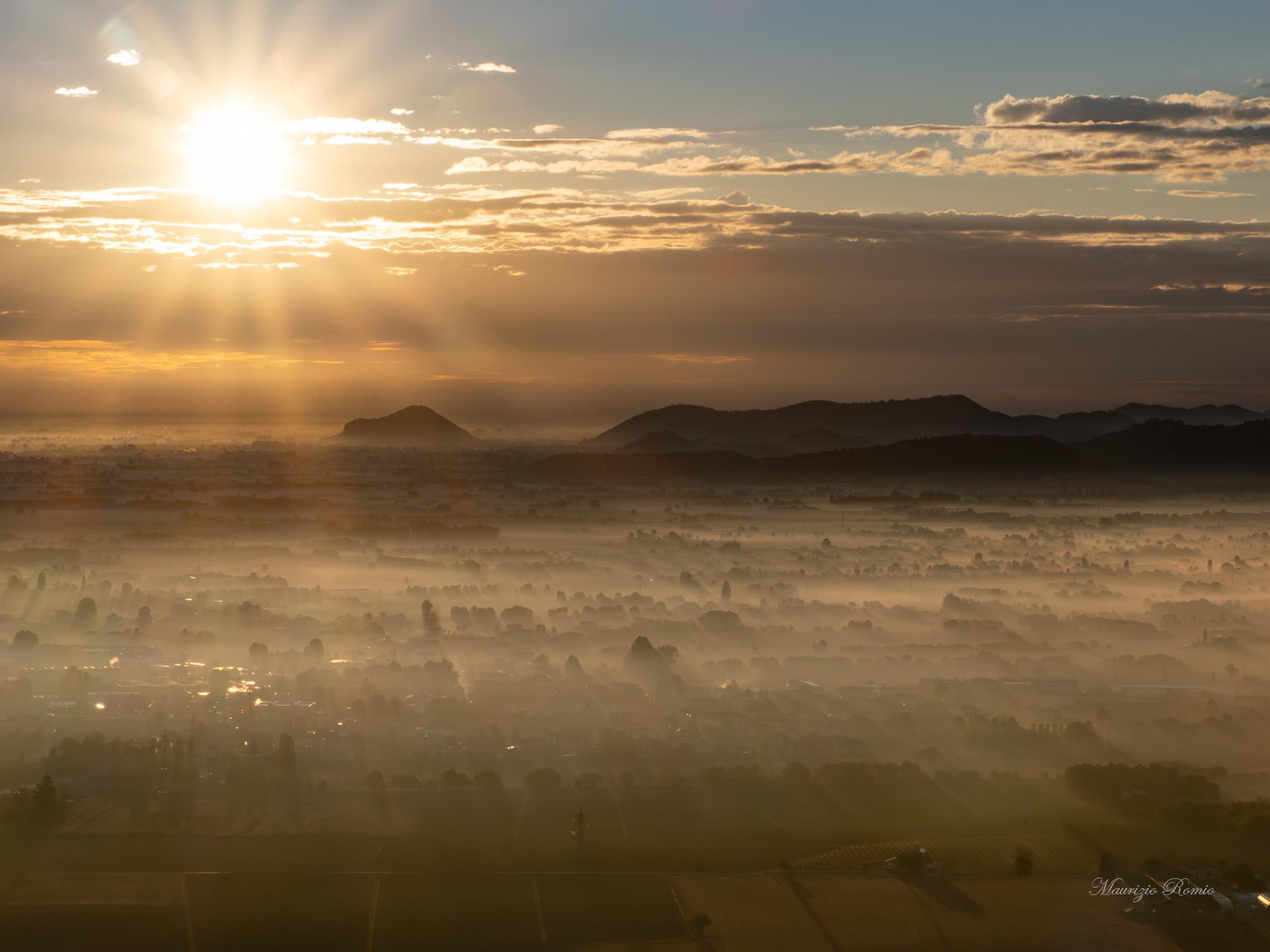
The image I captured early in the morning, with the landscape immersed in water vapor, made me think that “the Earth breathes,” leading me to some reflections.
Breath of life
Breath -> vapor -> water -> Life
Breath is the air that a living being exhales during respiration; it is composed primarily of atmospheric gases and water vapor.
Ogotemmêli[i] states: “The vital force of the Earth is water. God kneaded the earth with water. In the same way, He created blood from water. This force exists even within stone, for moisture is everywhere.”
It is written in Genesis: “Then the Lord God formed man from the dust of the ground and breathed into his nostrils the breath of life, and man became a living being” (Genesis 2:7).
The term “living being” links humans to all other living creatures.
But what, then, specifically distinguishes humans from other living species—whether animal or plant? In his essay “On the Immortality of Animals”, the theologian Eugen Drewermann argues that animals possess an immortal soul. According to the Jesuit Giovanni Marchesi, the distinction lies in the fact that humans,unlike other living beings, are gifted not only with a body and a soul, but also with the Spirit. In the New Testament, the conclusion of the First Letter of Saint Paul the Apostle to the Thessalonians reads: “May the God of peace sanctify you completely, and may your whole spirit, soul, and body be kept blameless at the coming of our Lord Jesus Christ” (1 Thessalonians 5:23).
The power of the Word
“Just say the word, and my servant will be healed,” we read in the Gospel (Matthew 8:5–13; Luke 7:1–10). Does the word possess power? It contains the elements of life—both physical (water and warmth) and spiritual. The word can heal, wound, kill, forgive, save, condemn, bring happiness or sadness; the word is vital energy.
“And man, having power over the word, can direct this vital force,” states the essay “Muntu. The Modern African Civilization” (Giulio Einaudi Editore, Turin, 1961, p. 134). On page 135 of the same book, the Dogon sage Ogotemmêli reaffirms: “In this world, the word belongs to everyone; it must be exchanged, allowed to flow back and forth, for it is a good thing to give and receive vital forces.”
[i] P. 51, “Conversations with Ogotemmêli” (original French title: Dieu d’eau) by Marcel Griaule. Publisher: Bollati Boringhieri. Publication date: October 25, 2002. Reprint: March 2025.
///
Bibliography:
“Muntu. The New African Culture“. Publisher: 1961, Giulio Einaudi Editore S.p.A., Turin. Translated by Gustavo Glaesser. First edition in the “Reprints Einaudi” series, 1975.
Note: “Muntu.The New African Culture” is an essay by the German ethnologist Janheinz Jahn, first published in 1958. Original title: “Muntu. Umrisse der neoafrikanischen Kultur”. Publisher: Eugen Diederichs Verlag, Düsseldorf.
***
“Conversations with Ogotemmêli: An Introduction to Dogon Religious Ideas” (original French title: “Dieu d’eau”) by Marcel Griaule. Publisher: Bollati Boringhieri. Publication date: October 25, 2002. Reprint: March 2025.
Notes:
“Conversations with Ogotemmêli: An Introduction to Dogon Religious Ideas” recounts the life and culture of the Dogon, a people from Mali, through the eyes of Ogotemmêli, an elderly hunter who had become blind following an accident. He was chosen by Dogon priests and elders, specifically for his extraordinary memory and intelligence, to reveal the complex cosmogony of his people to Griaule. In 1946, the author, Marcel Griaule, recorded his conversations with Ogotemmêli regarding the Dogon belief system and subsequently published them in a book titled “Dieu d’eau: Entretiens avec Ogotemmêli” (1948).
***
“On the Immortality of Animals” is an essay by the German theologian Eugen Drewermann. Originally published in Germany in 1990 under the title “Über die Unsterblichkeit der Tiere” by publishing house Walter Verlag, the book was published in Italy by Neri Pozza Editore in 1997 and subsequently republished by Castelvecchi in 2013. The work includes a preface by the writer Luise Rinser.